Migombani Organic Farm
Kenya
 477
477
Short description of your place and practices
When Salim founded Migombani Organic Farm in 2011, he began focusing mainly on banana production and this is where the name Migombani (meaning; Banana plantains) mushrooms, a variety of perennials, indigenous vegetables and an animal rearing system consisting of poultry (chickens, ducks, guinea fowls, turkeys), rabbits, goats and cows. He saw in this plants the potential to save people in rural areas from poverty and dramatically improve their nutrition.
But when partnered with Lenox, on January - 2023, and when they started to establish a productive plantation using a Permaculture farming method (an International PDC Course they studied together in November, 2015) they realized that the soil ph wasn’t good to successfully produce high-quality crops. Decades of monocultures and industrial agriculture depleted the soil of its nutrients and its capability of hosting plants, sentencing it to sterility. This problem not only affected Migombani, but also hundreds of other farmers in the coastal region. Salim had to find a new way to change the soil features and needed to drastically change methodology. That’s how he decided to shift Migombani Organic Farm to agroforestry, and more precisely to syntropic farming.
Farm and farming system
Details of the farming system
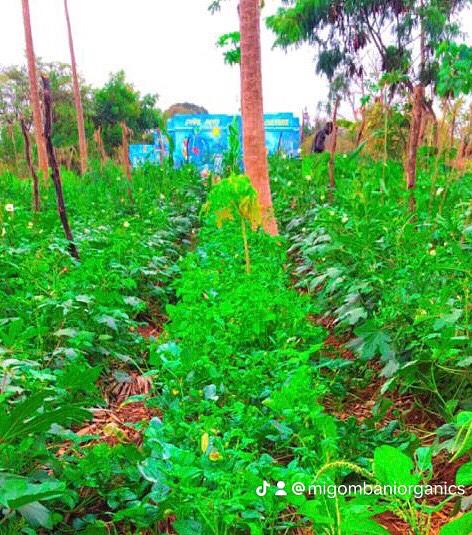
Migombani is building a food forest based on the principles of syntropic farming. They are trying to build a regenerative, climate-smart farming system; and build soil using biomass-derived from weeding and integrate local plants to help support biodiversity. They integrate iron and nitrogen-fixing plants in the farming system, trying to avoid disturbing the soil, also known as successional agroforestry.
What is your dream for the future of your farm and/or your location in general?
Migombani’s cheif goal is to be an example for other small-holder farmers, youths and big companies to show that it is possible to make a profit while restoring the environment. We also believe that in order for food to be healthful, the environment in which it grows has to be healthy. To that end, we intergrate animal, poultry, fresh water fish and bio diversity plant systems in ways that, in their natural interactions, they create an ecological balance leading to abundance and quality. The whole system is intelligently designed to both grow quality products and create accumulative systems that could serve a broader local and international market.