
Where it is realized
Summary description of agroecological practice
I want to show that whatever the surface area of land that we cultivate, any farmer can be totally independent of inputs from outside his plot. That his production can be perfectly sufficient for him, but also to sell the surplus.
Likewise, I wish to show that trees are very important in agriculture, and that they are essential allies for sustainable and productive agriculture.
Finally, I want to show that cultivating a micro plot of forest endemic to your area allows you to earn money, while improving yields.
Type of agroecological practice
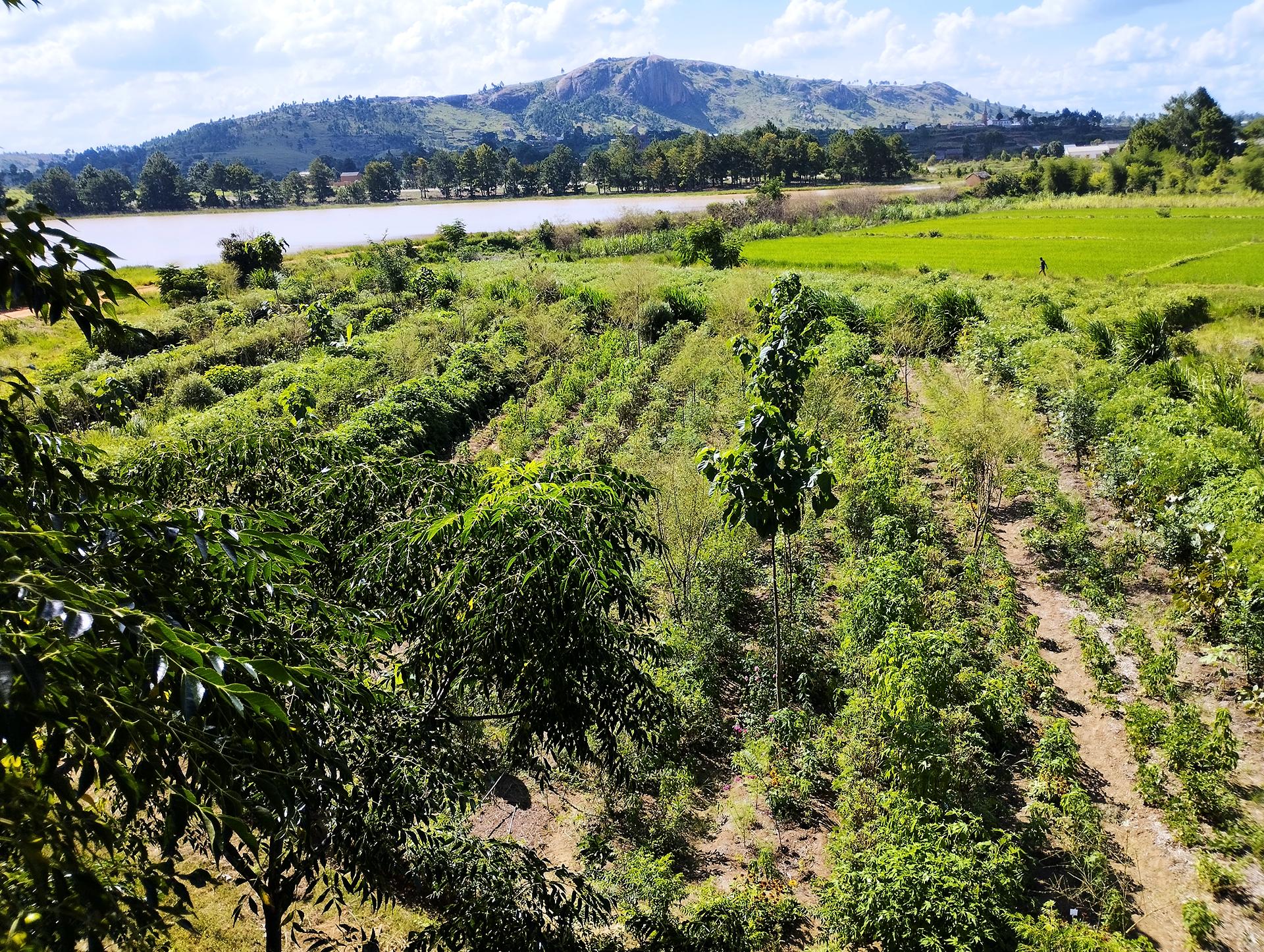
I cultivate 20% of my land with live hedges made up of three different plant species. A 30 meter hedge is cut every week, producing 2m3 of compost. At the end of two months, I would have cut 9 live hedges, and would return to the first which would then be cut again, and so on.
I also integrate many trees into my crops: fruit trees of course, under which my vegetables grow, but also fodder trees to feed my future cows. For the moment, I am content to cultivate them and calculate the leaf yields of these trees to know how many cows I could feed in two years on my plot, without needing to grow grass.
Finally, a small part of my plot (600m2 on 1.5ha) is planted with endemic plants and trees in order to grow a small natural forest, which will produce litter that I could use to make LIFOFER (forest litter). fermented), and enrich my soil with useful fungi and bacteria.
Between all these trees, I cultivate around 200 varieties of flowers and vegetables every year, in order to produce selected and resistant seeds since I strictly do not use any pesticide that is not grown and produced in my fields.
Implementing the practice
I start by cultivating my hedges first, at the start of the rainy season. After 4 months, my hedges start to be productive. I then start to make compost, which will later enrich my plots. So, I produce 96m3 of compost on 1ha of cultivation, even though the compost is 3 times richer than cow manure. Here, in Madagascar, on average only 30m3 of manure per hectare is used. In comparison, I produce 10 times more fertilizer!
I only work with flower beds: a hedgerow bed, 3 crop strips, a hedgerow bed, and so on. The central strip of each growing block is planted with fruit trees, every 6m to make room for vegetables. Thus, I am independent in fertilizers, in pesticides (since I cultivate 2% of my land with pesticide plants), in vegetables, and in fruit too!
Why you use and what you expect from this practice?
With these practices, I aim for total autonomy, to show that it is possible, and my products are completely free of chemicals and therefore better for health